

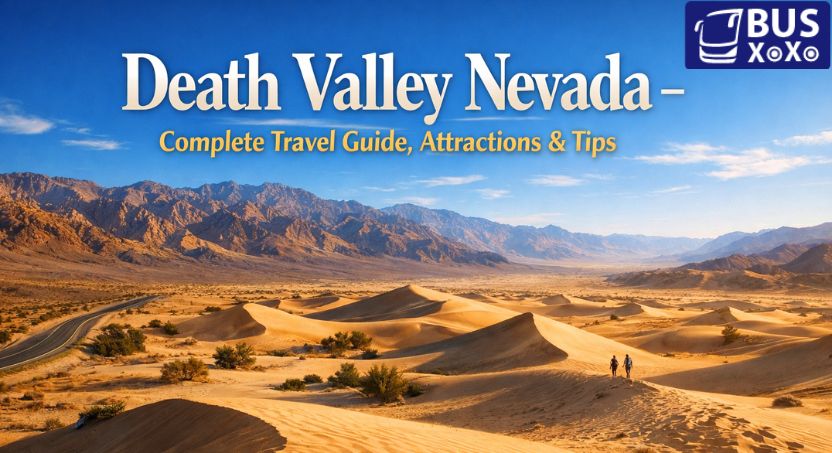
Death Valley is located in the Mojave Desert, running through both Nevada and California, one of the most splendid and beautiful scenery in all over the world. With its own rich history, it is North America’s hottest, driest and lowest national park. It is an attractive place for explorers who can see beautiful desert landscapes and unique rock structures. Here, visitors can find and feel the power of nature and the pristine beauty of desert. Visitors are able to see wonderful places like golden dunes, colourful canyon walls and vast plains. This place has two major attractions Zabriskie Point and Dante’s view which gives an unforgettable experience. Whether you’re solo or together, there is always something for everyone to discover in this valley such as its very beautiful attractions, landscapes, diversity and more.
What Is Death Valley In Nevada?
Death Valley is in southeastern California, just east of the Sierra Nevada. This park is bordered by Death Valley, Panamanian Valley, Eureka valley and many other saline valleys. It is among the largest national parks in the United States. The lack of surface water and low relief make this valley one of the hottest, driest and lowest national parks. Death Valley and Panamint Valley are the two primary valleys of this park.
Death Valley is home of lots of birds and animals like desert bighorn sheep, coyotes, kangaroo rats, desert tortoises etc. It is also home to some 200 bird species, including roadrunners and ravens. The rugged condition of this area is home to many plant species such as creosote bush, Joshua tree, honey mesquite and various types of pines. This is the fifth-largest American national park. This area is called Dark Shy Park by the International Dark-Sky Association.
A Rich History of Death Valley
Many years ago, Death valley Nevada, was the home of Native American groups who lived in the harsh desert environment of the desert. The main residents of this place were Timbisha Shoshone who lived for more than thousands of years around the valley. Timbisha used to survive in the valley according to the seasons. In winters, they used to live on the valley floor where foods were available, such as mesquite beans, small animals, etc. During summer they lived in the surrounding mountains where temperatures were normal and food could be available. They used natural springs, crafted tools from stone and fibres, which were helpful in making shelters in desert life.
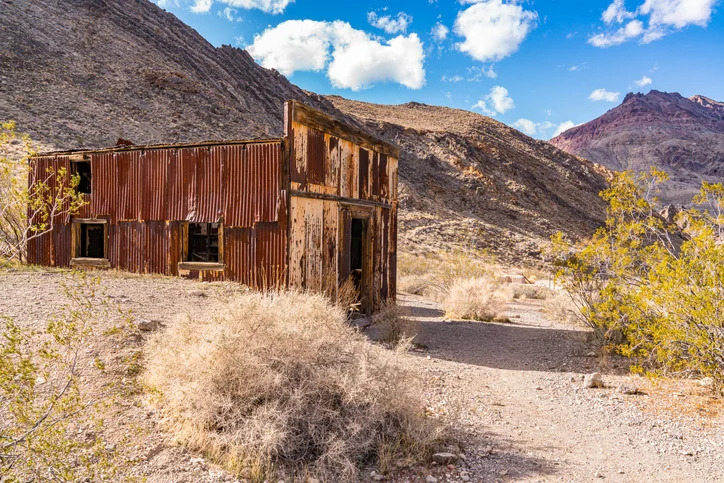
The name of Death Valley originated in the mid-19th century in 1849. According to history, groups of pioneers were travelling to California in search of gold during the California Gold Rush. Many of the travellers became trapped in the valley because of poor maps, lack of water and extremely rough land. According to historical accounts, when one group finally climbed the valley, a woman among them shouted, “Goodbye, Death Valley”. This became the official name of this valley.
Death Valley is connected to the California Gold Rush. In 1848 in California, gold was discovered and in the hope of becoming healthy, many migrants travelled across the valley. During the nineteenth century, the surrounding region of the valley became important for mining and many prospectors discovered several metals, including silver, gold, etc. The mining boom attracted workers, entrepreneurs and settlers to build temporary towns and infrastructure. This area’s unique landscape helped in preservation of this valley as a National Park.
Top Attractions in Death Valley
There are various popular attractions, some of them beautiful landscapes, panoramic views and many others. Some of them
Badwater Basin – The Lowest Point in North America
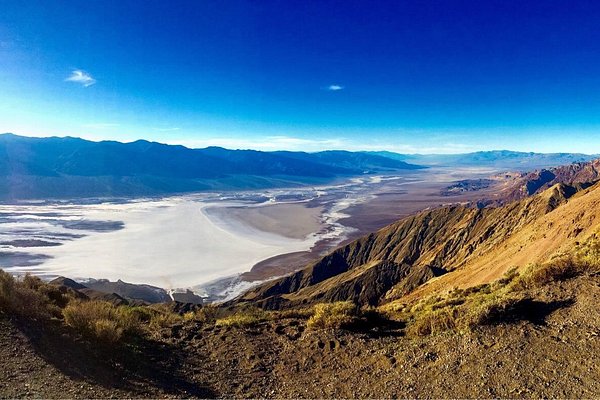
Badwater Basin, an endorheic basin in Death Valley, Nevada Lowest point in North America at 282 feet below sea level. This area is referred to as a minor “Bad Water” pool. It is in the shoulder ditch where spring water accumulates. So making it undrinkable as the salt collects in the area surrounding it. This is the reason that this basin is called the “Badwater Basin”. Mount Whitney is the highest point in the United States which is only a few miles to the northwest of this basin. You can also find a few plants and animal life such as pickle weed, aquatic insects, badwater snails, etc.
Zabriskie Point – Famous Sunrise Viewpoint
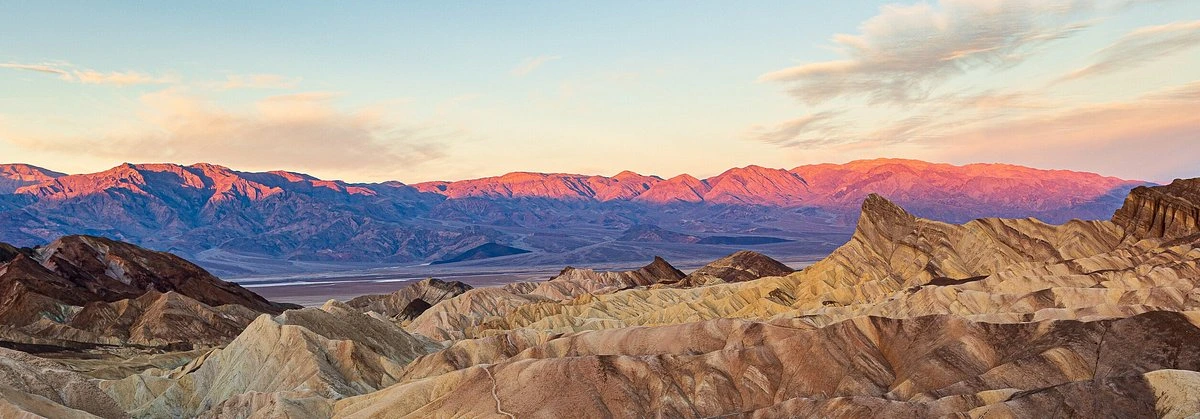
It is a part of Amargosa Range which is located in Death Valley which is famous for its wonderful landscape. This point was named after Christian Brevoort Zabriskie in the twentieth century. This location is considered the most loved in Death Valley National Park. This place appears in yellow and brown striped hills because of the powerful flow of water. The most beautiful place at this point is Manly Beacon. This place is mainly famous for its sunrise and sunset views where visitor found ravens, roadrunners, hummingbirds & rattlesnakes.
Mesquite Flat Sand Dunes
It is one of the most famous and easily accessible attractions in Death Valley which is covered with Mountains. It is a spectacular natural phenomenon of Death Valley which consists of various dunes around 100 feet high. This provides beautiful views of the surrounding mountains. The main source of dune sands is the Cottonwood Mountains which lie in the northwest of Death Valley. The largest dune is Star dune. This is located at the point where various winds which help to shape the dunes converge. You can see kangaroo rats, sidewinder rattlesnakes or desert kit foxes in this place.
Artist’s Palette and Colourful Hills
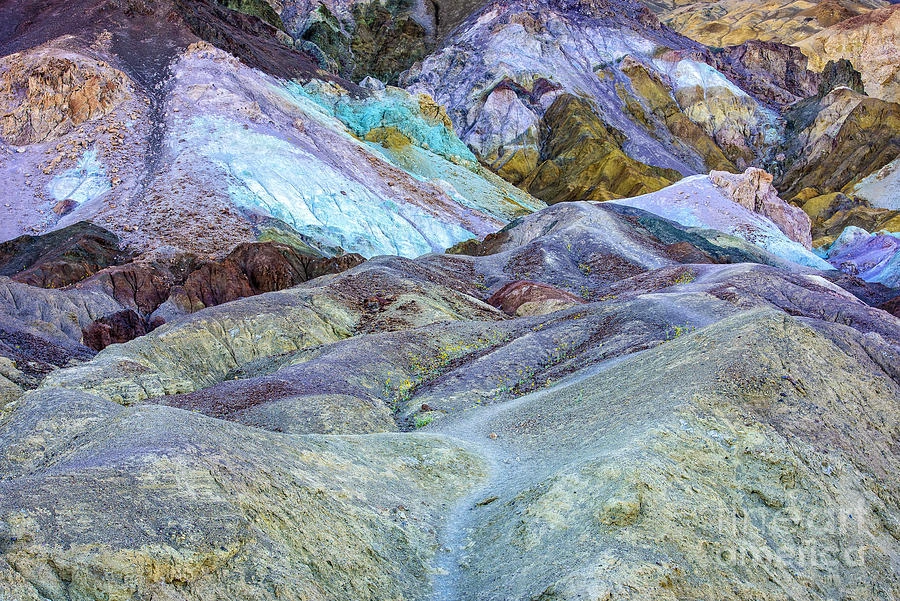
This location is a remarkable rock formation in Death Valley. The hills appear as the spectrum of colours on the rock face because of the shiftness of the sun’s angle. This happens because of the oxidation of different metals like iron, mica or manganese etc. This phenomenon is the result of many explosive volcanic periods.
Best Things to Do in Death Valley Nevada
Some of the best things to do in Death Valley are given below:
- Climb the Golden Canyon which is located between two separate trails of Zabriskie Point and Badwater Road.
- Visit the Lowest Point in North America – Badwater Basin.
- See sunrise and sunset views at Zabriskie Point.
- Visit Mesquite Flat Sand Dunes
- Drive through Artist’s Palette to see the colorful mountains
- Take the view from Dante’s View
- Visit a Hidden Desert Waterfall
- Relax in Remote Hot springs
- Go stargazing. Death Valley is fu
Visitor Information and Travel Tips
Here are some of the important travel tips for visitors-
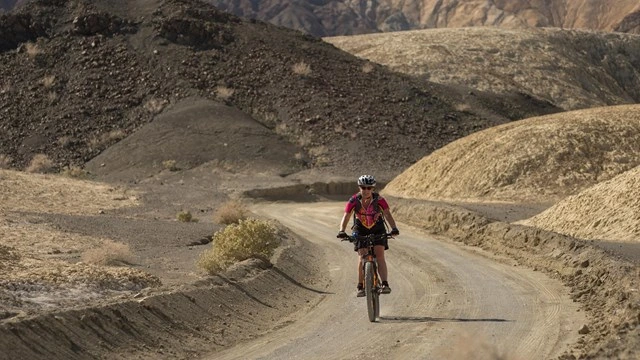
- Best Time to Visit – From November to March is the best time to visit Death Valley because in summers, temperature may rise to 49 degree celcius to 120 degree fahrenheit. This is not considered a good time to visit Death Valley.
- Bring Lots of Water and Fuel for huge and long distances.
- Entrance Fees – 30 dollars per vehicle for 7 day pass and more than it for longer days.
- Safety & Precautions – Always keep water with yourselves because dehydration can happen anytime rapidly.
- Download maps offline and depend on paper maps.
How to visit Death Valley, Nevada
Death Valley is a lovely tourist place that is about a three hour drive from Las Vegas and five hours from Los Angeles. You can also choose CA-190, NV-160 to Pahrump and US-95 to Beatty routes. Rental cars, flights and charter buses are easily available for exploring these locations. Las Vegas’ closest airport is the Harry Reid International Airport which can be helpful if you’re visiting by flight. Driving roads in parts is good, though only four by four vehicles are better in some cases.
Conclusion
Death valley Nevada, is a wonderful place in North America which features beautiful landscapes such as Badwater Basin, Mesquite Flat sand dunes, etc. The best time to visit this place is during the cooler season. It also offers hiking, stargazing and many other unique activities. In this blog, we have covered each and every point required as for travel tips. Experience the beautiful scenery by creating unforgettable memories with your friends and family.