

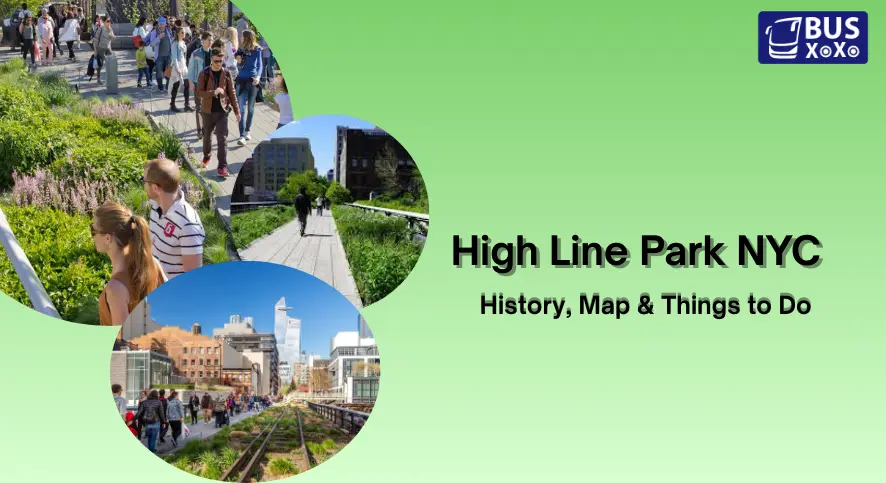
Have you ever experienced walking on a park that is elevated, lush, and is approximately 30 feet above the street? The High Line NYC is a place that offers such an out-of-the-ordinary experience just among the top urban parks in the world. This 1.45-mile-long elevated greenway renovates a former railway into a spectacular public space with more than 500 types of plants and trees. The rail line that was historically left to rot has actually been converted to one of the most influential instances of contemporary American landscape architecture and presently is the location that nearly 8 million people annually visit.
While organizing our excursions, we are often forced to think about the logistical parts of the High Line NYC map in order to move around the districts of Greenwich Village, the Meatpacking District, Chelsea, and Midtown Manhattan. Additionally, knowing the distance of the High Line NYC (2.33 km) enables you to estimate the duration of your walk. For those who are visiting the area for the first time and are asking what the High Line NYC really is, it is basically a hanging park that is often referred to as “the park in the sky”. Moreover, having an idea of where the High Line comes from and where it goes as well as checking the High Line NYC hours before your visit, will help you to have a great time in this stunning urban oasis.
We will guide you through the list of things that you have to know about this fabulous NYC attraction that has been changing the city’s landscape since it opened in June 2009 in this guide.
The Origins of the High Line
Long before becoming a tourist attraction, the High Line NYC stood as a solution to a deadly urban problem. The story begins not in the sky, but on the dangerous streets of Manhattan’s West Side.
From Street-Level Danger To Elevated Safety
The development of the High Line can be traced back to 1847 when New York City decided to put railroad tracks along Tenth and Eleventh Avenues. These street-level freight trains delivered necessary goods like coal, dairy products, and beef to Manhattan’s industrial areas. Sadly, these trains were the source of dangerous situations for people walking on the streets. In 1910, it was reported that over 540 individuals had lost their lives because of trains crossing these streets; thus, Tenth Avenue got the dreadful nickname “Death Avenue”.
As a result of the increasing death toll, the New York Central Railroad engaged “West Side Cowboys”, men on horseback, to guard Tenth Avenue. These courageous men rode ahead of the coming trains and waved red warning flags to let people know that it was dangerous to be there. The “cowboys” were unable to prevent accidents from happening in the area, which led to discussions among the public about the necessity of solving the problem once and for all.
The West Side Improvement Project
The change of heart came with the 1929 moment when the city officials, the state, and New York Central Railroad together made a bold decision to go for the West Side Improvement Project. This huge operation, which was the idea of New York City park commissioner Robert Moses, was meant to do away with the street-level crossings that were the source of accidents forever.
- The 13-mile project was thorough in its ambition:
- It did away with 105 street-level railroad crossings
- Added 32 acres to Riverside Park
- Included construction of the West Side Elevated Highway
- Cost over $150 million (equivalent to about $2.75 billion today)
The changes necessitated by the project to the West Side of Manhattan were considerable. 350 properties with 640 buildings in total were taken over for the purpose of demolition to clear the way for the new elevated structure. Still, this radical change meant a safer and more efficient transport system for the expanding city.
Opening of the West Side Elevated Line in 1934
On the 29th of June, 1934, the High Line viaduct was formally recognized as the first finished segment of the West Side Improvement Project. However, the opening train had already been run on the viaduct in 1933 a year before the official dedication. The “West Side Elevated Line”, as it was first called, was a facility that was conceived with outstanding anticipation of future needs.
Instead of going over streets, the elevated roadways were brought right through the middle of blocks thus making a direct connection possible to factories and warehouses. The revolutionary plan enabled the railroad cars to be loaded and unloaded in buildings while the street traffic went on undisturbed beneath. The initial line extended from 35th Street down to St. John’s Freight Terminal at Spring Street.
The positive effect on the economy was immediate. Meat, dairy, produce, and manufactured goods were the main commodities transported on the High Line through Manhattan’s industrial West Side by the Central New York Railroad. Central New York Railroad was so excited about this accomplishment that in their announcement they said that the project would “bring about a new era for the industrial West Side.”
It was indeed by 1941 that the very last portion of dangerous street-level tracks had been taken away from Eleventh Avenue thus putting an end to the time of the West Side Cowboys and their red flags. What started as a rescue measure, the High Line had evolved into an essential part of New York’s industrial infrastructure, a position it held for years until its farewell and amazing revival into the park that we see today.
Transformation into a Public Park
The NYC High Line transformation is a story that moves the city out of its way: one of the most triumphant urban reclamation ventures of the 21st century, it went from an abandoned railway to a lively public space. Once the structure was rescued from being torn down, the actual job that of redesigning what this elevated railway could be started.
Design Competition And Public Support
Back in 2003, Friends of the High Line, decided to generate publicity for the High Line’s potential by holding an open international ideas competition. Initially, they were only expecting to collect a few entries, however, due to such an overwhelming response, they ended up with 720 proposals from 36 different countries with ideas varying from the most practical to the most imaginative ones like a one-mile-long swimming pool and a roller coaster.
The competition played a crucial role in the decision-making process when it was still very uncertain and therefore it was helpful to have more people involved in the conversation and to get the excitement about the future of the structure raised.
That was not the end of it. In 2004, Friends of the High Line and the City of New York, arranged a design competition by invitation only. Out of the 52 initial teams, consisting of experts in architecture, landscape architecture, engineering, art, urban planning, and horticulture, four finalists were selected. Their work was exhibited to the public at the Center for Architecture in New York. As a result, the steering committee made up their minds and chose the winning team in October 2004.
Key Players: Architects And Landscape Designers
The transformation of the High Line required a multidisciplinary approach, and these three main figures: the landscape architecture firm James Corner Field Operations (project leader), the design studio Diller Scofidio + Renfro, and the famous planting designer Piet Oudolf, were the leaders of it. Their shared “agri-tecture” concept—one side being agriculture, the other architecture—was going to be the signature of the High Line.
Mayor Bloomberg’s administration gave the essential political support to the project, thus, it was first backed by the administration in 2002. Moreover, the establishment of the West Chelsea Special District in 2005 made it possible for the High Line to be reused through a well-thought-out rezoning plan. This change induced The New York Times to headline “Frog of a Railroad to Become Prince of a Park”.
Best Things to Do at the High Line NYC
The best things to do at the High Line NYC, which you must try when you arrive.
Enjoy the Elevated Gardens
The High Line has so many beautiful areas of plants, flowers, and trees, when you can start walking there on a path you will see so many different types of trees, blossoms, are there, which makes this place more special. The calm and green areas make the whole mood calm and fresh, and mostly in the middle of busy Manhattan.
Visit the Chelsea Market Passage
When you are near the 15th street section, and there you will search a covered place with some sitting spots and some beautiful artworks after the High Line, there you can go straight into Chelsea Market, which was more popular for its foods, snacks, and important things for shopping. Moreover, it was an ideal choice for those who needed a break or tasted something different there.
Explore Art Installations
All over the trail, when you will search something creative art pieces, canvas, and painting. Then this place attracts you when you visit. Their artworks change your whole mood. Their paintings change from time to time, so whenever you visit you feel different every time. However, it is an ideal choice for those people who want to enjoy modern artworks.
Capture Stunning Photos
The High Line in NYC always gives some different angles of skyline, the Hudson river, and the most special building around the Chelsea. If you love to capture some memorable moments in frame, then you should definitely visit this place.
Relax at the 10th Avenue Square
This place has huge steps, where you can sit, and enjoy the view of the street from above. So many people stop here to rest their body and watch the traffic below, and take some pictures. It is one of the most famous places on the High Line.
Walk to Hudson Yards & See the Vessel
When you walk in the north side of the path, then you will reach the most famous place the Hudson Yards. There you can see the Vessel, which was very huge and famous there. If you need more excitement and a peaceful walk then you have to visit there, and explore the mall.
Enjoy Sunset Views
At the end of the day, if you visit the Hudson River, then you will definitely see the sunset views. The stunning calm light, clean air, and beautiful environment in a relaxing spot, makes your day more exciting and memorable.
Nearby Attractions Around the High Line
The nearby attractions, which you have to visit at least once.
Chelsea Market
The Chelsea Market is one of the most famous spots to visit near the High Line Park in NYC. when you want to taste some tasty snacks, then you will definitely check out this place. Their food hall and tasty snacks, or desserts, or fresh seafood, and so many different shops, make you more excited. It is the best place to relax and try some new foods, and explore local flavours.
Whitney Museum of American Art
The Whitney Museum of American Art is situated right near the southern way of the High Line, the Whitney Museum is a good choice for those people who want to enjoy modern, and American arts. This museum has large art galleries, creative exhibitions, and a beautiful skyline view of the city. Even if you are not interested in arts and exhibitions , their calm environment makes your day more exciting.
The Vessel (Hudson Yards)
When you walk in the northern way at the end of the High Line, then you will see the most famous place, Hudson Yards, it is a landmark to the famous Vessel. This amazing cylindrical structure is one of the best places for pictures in New York City. The area near the Vessel has an open area, or restaurants, and a shopping place. It is an ideal way to end your High Line tour with beautiful views in a calm place.
Little Island
Little Island is a very different water park on the Hudson River, which is situated very close to the High Line. There you will see the beautiful green areas, and quiet places to visit to relax your mind. If you want to enjoy nature and get some clean air, enjoy the view. then this place is an ideal choice to visit.
Conclusion
The High Line Park in New York City is a spectacular example of how an urban area can be transformed and made innovative. The park has been transformed from an abandoned old railway that was left without use to a new public space full of life that is a perfect mix of nature, art, and architecture elevated over the city streets. The park’s past, going from an industrial era to the current one, is a metaphor of New York’s power of change.
Now people can walk through the park with its lovely landscaping and see the beautiful view of the Hudson River. They can also visit art pieces and participate in cultural events that are always going on. High Line is a brand-new view of the city for every local and tourist, an amazing mixture of the past, the creative side, and the neighborhood that is still determining the future of the way cities will be designed.