

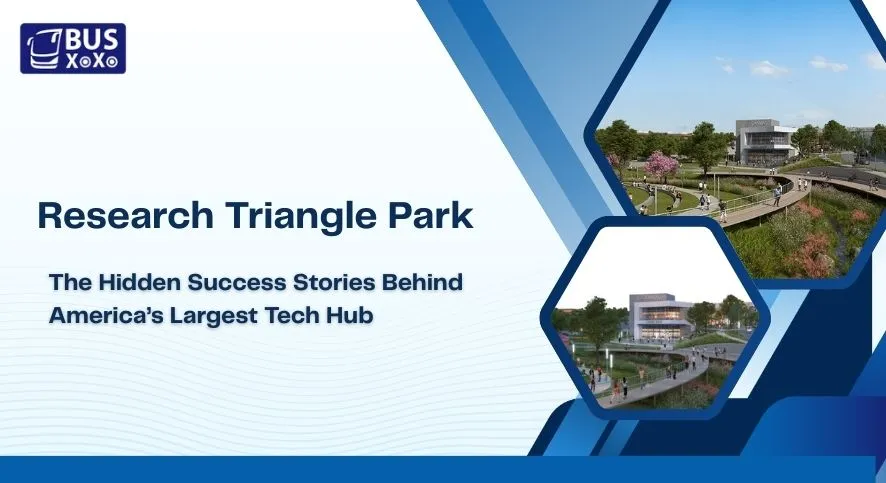
Research Triangle Park is a research park in the US that covers an area of 7, 000 acres in North Carolina, and is the largest research park in the United States. When we reflect on its fabulous 65 year journey, it’s very understandable why RTP is such a dominant player in America’s innovation scene. Currently, this energetic center is home to over 375 companies that collectively provide more than 60,000 jobs. Among them are major enterprises like IBM with its huge 774,000 square foot corporate complex and GlaxoSmithKline’s R&D center having around 5,000 employees. What’s really amazing is the way Research Triangle Park changed the region economically as it was considered one of the poorest areas of the southeastern United States back in the ’60s and now it has become one of the richest areas.
In this article, we will look at the brains behind the idea of Research Triangle Park North Carolina, find out what the companies within the park created that led to the world breakthroughs such as the UPC code and 3D ultrasound, and learn how this amazing technological environment is still developing for the future. If you are looking for Research Triangle Park jobs, or you are simply wondering about the oldest continuously operating research hub in America, the history of this development that has brought about great changes can give you an understanding of how regional innovation can be supported.
The Origins of Research Triangle Park
The foundation of North Carolina’s most significant economic development project began amid challenging circumstances that threatened the state’s future prosperity.
The Economic Decline Of Post-War North Carolina
North Carolina suffered an economic slump after World War II. In 1950, the state was second to last in the country in terms of per capita income, ranking 47th out of 48 states. An individual in North Carolina earned $1,049 on average yearly as against the national average of $1,639. Because of a heavily agriculture, based industry that kept low, wage jobs as a norm, mainly in the areas of tobacco, textile, furniture manufacturing, and small, scale farming, the state was struggling economically. In addition to that, we can say that the state also had problems with the “brain drain” of leaving university graduates going outside for better jobs. This departure of the educated workforce was another way in which North Carolina’s economic future was in jeopardy. Therefore, there was an immediate need for governmental intervention to save the state.
The vision of Romeo Guest and Governor Hodges
The idea that would later be known as Research Triangle Park was initially introduced through Romeo Guest, a building contractor from Greensboro, who came up with the term “Research Triangle” in 1953. After the failed attempt to lure pharmaceutical giant Merck to North Carolina in the early 1940s, Guest started campaigning for the project. His idea was given a huge boost by Governor Luther Hodges, who gave the official go, ahead to the project in 1956 and supported what he termed as “business progressivism”. Hodges said that the forming Research Triangle was going to be “the heart and hope of North Carolina’s industrial future”.
At first, it was planned as a for profit venture, the project changed its course under the leadership of Archibald “Archie” Davis, who turned it into a non profit model. Later on, Davis managed to gather $1.43 million in donations from North Carolinians to acquire the RTP site.
Why the ‘Triangle’ concept was revolutionary
The true genius of Research Triangle Park was that it was strategically located at the center of three world class research universities: Duke University, North Carolina State University, and the University of North Carolina at Chapel Hill. It literally and figuratively created a triangle of intellectual resources that companies could obtain while setting up their own independent research facilities.
This was very bold because it was trying to achieve a scale where academic research would be a direct source of industrial development, which is hardly ever done. The founding mission was simply to “encourage and promote the establishment of industrial research laboratories” while cooperating among the universities and industry.
It was a struggle at first, but IBM’s announcement of a 400 acre research facility at the park in 1965 changed everything. This breakthrough, along with the Department of Health, Education, and Welfare’s decision to locate a major center at RTP, paved the way for continuing expansion and innovation for decades to come.
Building the Foundation: From Idea to Reality
Transforming the ambitious Research Triangle vision into physical reality required establishing proper governance structures and overcoming significant early challenges that nearly derailed the project altogether.
The role of the Research Triangle Foundation
The Research Triangle Foundation of North Carolina was formed in January 1959 as the park’s caretaker and manager. This is a nonprofit organization that was purposely set up to line up collaboration between government, academia, and industry. Different from most development projects at that time, RTP’s founders consciously rejected government control, they rather opted for a private project in cooperation with universities. The establishment of the foundation was preceded by a phenomenal fundraising effort led by Wachovia Bank president Archie Davis, who raised $1.43 million from more than 850 donors throughout North Carolina. The money raised was used to buy around 4,000 acres of mainly infertile pine forest and farmland lying halfway between Raleigh and Durham.
University Collaboration And Early Skepticism
Even though the Research Triangle Park had three top, notch universities as its main partners, the idea of RTP still had its share of disbelief between 1960 and 1965. Many people wondered if companies really would move their research to the South when they knew the region mainly by its backwardness and when there were no factory facilities for the “new, line” industries there. Besides, companies had always kept research facilities close to manufacturing sites which were mainly located in the Northeast and Midwest areas. Walking this difficult path, the only company that signed up to the park was Chemstrand (a joint venture of Monsanto and America Viscose). “There was skepticism and paranoia, ” she summarizes the local mood of that period.
How Ibm And Federal Support Changed Everything
Through two landmark announcements that quieted critics, the park’s fortunes were quite totally reversed in 1965. Firstly, after a persistent four, year pursuit, National Institute of Environmental Health Sciences (NIEHS) finally agreed to set up a $70 million center for research at RTP. Then, three months later, International Business Machines (IBM) declared their plan for a huge 600, 000, square, foot research facility on 400 acres within the park.
The announcement came after seven years of courtship, one of the ways a UNC professor Fred Brooks, a former IBM researcher, influenced the decision. These two happenings legitimized RTP’s idea immediately in fact, the credibility that they brought in would be the reason that the next few years dozens of other companies would be attracted to the area.
The Growth Years: Companies, Jobs, and Innovation
After the arrival of IBM in 1965, the Research Triangle Park witnessed exponential growth that transformed North Carolina’s economic landscape.
Major Companies That Shaped RTP
Once IBM had made a groundbreaking decision, RTP did not take long to become a magnet for big corporations, which wanted to benefit from the immense talent of the region’s universities. By the decade of the sixties, 21 companies had set up research facilities at the park.
The new decade welcomed 17 more companies coming in, among which were Burroughs Wellcome, Northern Telecom, and the National Humanities Center. The U.S. Environmental Protection Agency too set up its largest research laboratory in RTP. In the course of the 1990s, the whole area was generally known as “The Research Triangle, ” showing its increasing recognition.
At present, RTP is home to 264 companies that provide jobs to nearly 50, 000 skilled workers. Among the leading players, one can find Fidelity (8, 400 employees), IBM (7, 000), and Cisco (3, 700).
Breakthroughs developed in RTP (UPC, AZT, 3D Ultrasound)
RTP companies have brought innovations which have had a great impact nationally and globally. One example is IBM that created the UPC Barcode and Scanner, which changed the way inventories are handled and eventually becoming a business of USD 17 billion. Chemists at RTI International invented Taxol which is the most prescribed cancer drug in the history and has saved hundreds of thousands of lives. In the same vein, the work of Burroughs Wellcome that led to discovery of AZT (Azidothymidine) as the first drug to significantly extending the life quality of HIV/AIDS patients, was awarded a Nobel Prize. Besides these, Duke University scientists were the first to find out the 3D Ultrasound technology. Since the year 1976, entities in RTP have been granted more than 3, 700 patents.
How RTP helped reverse North Carolina’s brain drain
In the 1950s, North Carolina was losing a lot of its top talent as graduates from the universities in the state left the state in search of better opportunities elsewhere. As Research Triangle Park (RTP) expanded, this trend was turned upside down on a massive scale. Instead of being a classic example of brain drain, the region is now home to the highest proportion of people with Ph.D.s in the entire country. The average unemployment rate in this four, county region was only 3.3% in 1986, while it was 5.3% in the state and 7% nationwide. The success of the park helped form a collaborative ecosystem where businesses and universities mutually benefit each other e.g. IBM supported NC State’s robotics lab financially, while the faculty from UNC taught the management teams of IBM.
The Rise Of Research Triangle Park Jobs And Economic Impact
RTP’s impact on the economic transformation of North Carolina has been mind, boggling. NC has drastically changed from being the 49th in per capita income in the 1950s to 37th by the late 1980s. Today, the Triangle area produces about USD 178 billion in total economic output per year, which is 27% of the GDP of the whole North Carolina. The three universities around RTP are now bringing USD 3 billion in research funds every year, which, together with other sources, supports 20, 000 jobs. Adding Hub RTP and the growth of the park, the park could see its workforce more than double to 60, 000 people in the coming 15 years.
Modern Redevelopment and Future Vision
As Research Triangle Park moves beyond its sixth decade, the pioneering tech hub is undergoing its most ambitious evolution yet. This renewal aims to maintain RTP’s competitive edge in attracting future innovation and talent.
Hub RTP and the new urban center
Hub RTP is the chief element of the modernization effort, a $1.5 billion project covering 100 acres. The new downtown district packs together one million square feet of office and lab space, 1, 200 residential units, 279 hotel rooms, and 32, 000 square feet of retail. Among the initial projects to materialize are Horseshoe, a mixed, use development with restaurants and offices, plus MAA Nixie, RTP’s first, ever residential complex.
Boxyard RTP and community engagement
At the same time, Boxyard RTP is also revamping community interaction in a groundbreaking way by its 15, 000 square feet “cargotecture” development that has been very well thought out. This space, comprised of repurposed shipping containers, is designed to house local food vendors and retailers and also hosts music performances, fitness pop, ups, and maker markets on a weekly basis. By means of such schemes as the PopBox grant program, which has facilitated the handing out of more than $60, 250 to 11 small businesses, Boxyard is constantly supporting the growth of local entrepreneurship.
Sustainability and green space preservation
Environmental stewardship remains a priority at RTP even though the development is getting denser. One of the ways the park achieves this is by limiting impervious surfaces to allow for more green areas, less stormwater runoff and higher underground water recharge. Only Hub RTP has as much as 16 acres of green space which is linked to more than 20 miles of trails.
How RTP is preparing for the next tech wave
The comprehensive “RTP 3.0” vision, which was passed with a huge majority of 96% of the vote, adds three new place types to the world: Enhanced Corporate Campus, Residential Neighborhood Development, and Mixed, Use Density Node. This half, century plan is designed to direct RTP’s development in a smart and equitable way over its 7, 000 acres. In line with these changes, the proposed Triangle Mobility Hub, a $58 million transit center to be opened in 2028, is going to be equipped with electric bus infrastructure and be ready for passenger rail connection as well.
Conclusion
Research Triangle Park (RTP) is a shining example of how cooperation, new ideas, and a clear vision for the future can completely change the face of a region and make it a world leader in technology. This is one of the reasons why RTP is sometimes considered less famous than Silicon Valley. However, the success of RTP is mainly due to its strong ties with universities, a wide range of industries, and a continuous flow of skilled people. Biotechnology, clean energy, software, and research, based startups are some of the areas where the park has a major impact on innovation in the U.S. As firms expand and fresh concepts come to light, the untold success stories of Research Triangle Park firmly attest that environmentally friendly tech communities can successfully exist outside known centers.