

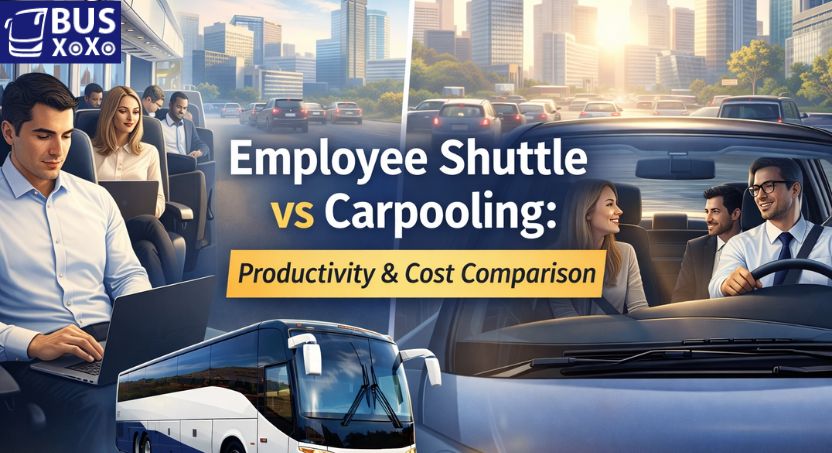
When you a planned any employee transportation and facing the confusion to choice between employee shuttle vs carpooling. Basically Employee shuttle and carpooling method can help to move employees efficiently but both are very different to each other in the term of cost, productivity, comfort and overall facility. Understand both of them option so you and your companies select the best solution for the workforce, trave l distance and manage everything in budgets. In this guide we cover all the important detail related to employee shuttle and carpooling and understand which one is overall perfect.
Understanding Employee Shuttle Services
Shuttles for employees are transportation services arranged/provided by a business that is dedicated to transporting employees to work. The shuttle runs on predetermined routes and has scheduled times to get the employees to work on time without the stress of driving their own vehicle. Most of these types of shuttles are either buses or larger vans with the ability to transport from 10 to over 50 people at one time.
Shuttles for employees usually provide additional amenities such as comfortable seating, considerable legroom, onboard Wi-Fi, climate control, power ports, and sometimes televisions for entertainment. An employee uses the transportation as not only an effective means for getting to/from work safely, but also as a means in which to utilize their time productively while commuting to/from work using the shuttles.
Key Advantages of Employee Shuttles
Cover the basic advantage for using Employee Shuttles for work:
- Staff can utilize time spent commuting for accomplishing many tasks such as responding to emails, attending virtual meetings, and planning their daily schedules.
- The reliability of the shuttle schedule is nearly perfect due to the shuttles being on a fixed schedule and managed by the company.
- The stress-free and comfortable environment of commuting enhances employee morale and satisfaction.
- Having branded shuttles displays a professional image of the company and positively impacts the corporate culture.
Challenges of Employee Shuttles
Before selecting the Employee shuttles discover this challenges listed below:
- Because of the high costs associated with owning and maintaining a vehicle, providing fuel to drivers, paying their salaries, and managing routes, the overall cost of operating vehicles is often very high.
- Shuttle services often do not provide much flexibility for employees who work irregular hours or for those who live outside a shuttle’s designated route.
- When an employee lives far from one of the shuttles’ designated pickups or drops,additional planning is required for first-mile and last-mile connections.
Understanding Carpooling
Carpooling is when people who work together drive their own private automobiles to their jobs together. They can create informally formed carpools with family, friends, or by utilizing organized, structured carpooling programs through mobile applications, etc. Carpools function best when there is a large number of employees living near one another and can effectively coordinate their schedules.
Key Benefits of Carpooling
Below are the main benefits commonly found on a Carpooling:
- Carpooling may be a very cost efficient solution (no company costs typically involved with what could be offered as incentives e.g., fuel reimbursements, preferred parking).
- Its help to create team work and develop personal relationships. You can interact with other employees easily and commuting with them to an from work.
- Promoting environmentally sustainable practices because they reduce the number of cars that are used as well as lower the amount of carbon based emissions from these vehicles.
- With flexible arrangements available, employees can determine their commuting preferences
- regarding pickup locations and times that accommodate their personal situations.
Challenges of Carpooling
Understand the challenges of Carpooling that are listed below:
- Limited opportunities for productive work exist during almost any type of travel since you can’t drive and accomplish something else (‘multi-task’) at the same time.
- Difficulty in coordinating schedules/participants may cause delays in doing business or relying on those participating in doing business together.
- Safety/liability issues exist for the company since they can only control the vehicle during the time that it is directly under their supervision.
- The reliance on a small number of drivers makes the dependent system vulnerable to last-minute cancellations, absences, or being able to accommodate all of the riders that need to be transported.
Key Differences Between Employee Shuttle vs Carpooling
When you want to compare employee shuttle vs carpooling so you can face lots of critical aspects. Understanding these distinctions helps companies select the right solution for their workforce.
1. Productivity and Work Efficiency
The major difference in productivity between employee shuttles and carpooling has to do with how the commute is used during travel time.
- Employee shuttles: This shuttles help you to work while riding and give you access of wi-fi, charging ports and other facility. You can check your works hold virtual meeting or plan things out during their time travelling back and forth. The time spent commuting becomes productive work time.
- Carpooling: Carpooling does not necessarily allow for the same level of productivity as employee shuttles. Passengers may sometimes be able to utilize handheld mobile devices while riding in a carpool but the driver cannot perform any work. Additionally, arranging a carpool and waiting for those who are carpooling to get ready adds additional time to the average commute making the entire experience less productive.
In summary, employee shuttles enhance employee productivity, increase time to be on-time, whereas, carpooling is a solution to get people from one place to another with limited productivity gains.
2. Cost Implications
Cost is another way that these different commuting options differ.
- Employee Shuttles: Employee shuttles represent both a larger initial cost and on-going costs for the employer (leasing or purchasing vehicles, fuel, maintenance and salaries for drivers), but for larger groups of employees this cost becomes predictable and scalable per employee.
- Carpooling: Carpooling can provide more economical solutions for company mass-transit programs as drivers share various costs (such as fuel, tolls, parking etc.) and employers may only have to provide relatively small incentives such as priority parking or reimbursements for fuel. In this case, the majority of these expenses will be borne by the employees.
Bottom Line: Employee shuttles are a higher-cost yet fully managed option, while carpooling is an economical option that is driven by the employees.
3. Comfort and Convenience
Different levels of comfort and convenience can be found on employee shuttles and carpooling.
- Employee shuttles provide overall comfort with ergonomic seating, ample room to stretch your legs, climate control in addition to potential on-board entertainment systems and/or restrooms. All of this provides for a less stressful and more relaxing commute for employees which leads to higher levels of employee job satisfaction.
- Carpooling offers different levels of the same level of basic comfort due to the type of car being driven and how willing the driver is to accommodate the passenger(s) riding with him or her. In addition, on a daily basis, the amount of amenities offered in the carpool can vary based on the driver, traffic patterns, and the type of car being used.
Ultimately, shuttles focus on providing consistent comfort, whereas carpooling focuses on offering basic levels of comfort with flexibility.
4. Schedule Reliability
The ability to stick to predetermined schedules enhances your company’s performance.
- Employees who believe in shuttles they have designated routes and they decide the time of those routes. Its offer them verify method that help to from work locations.Sticking to those routes and times is especially important when punctuality is critical to the success of an industry.
- Who believe in carpooling service they need to work together and coordinate the schedules. There are many reasons why the carpool group may not arrive together, including one member being delayed by traffic or another member being late to meet the group.
In summary, scheduled employee transportation via shuttles provides both a dependable and predictable commute; in comparison, carpools provide variable transportation with little to no guarantees.
5. Environmental Impact
Carpools and shuttles both serve the purpose of reducing negative environmental effects but do so in completely different manners.
- Using employees shuttles to transport groups of employees results in significant reductions in average carbon per-capita emissions as a result of many individuals being moved in a single vehicle.
- Though carpooling does provide an effective means of reducing emissions, in order to accomplish this through carpooling, there must be sufficient levels of carpooling participation to optimize routing efficiencies. For example if two persons are in a car, results would be lower than if an entire shuttle were filled.
6. Scalability
The other unique difference is the ability of these systems to “scale,” that is, accommodate “growth.”
- The employee shuttle program can easily be expanded to support larger teams on multiple routes, making it a good fit for medium-sized and larger organizations with a workforce of hundreds.
- If we talking about carpooling service is very limited for less number of employees who are close to one another. The ability of the carpooling program to expand and accommodate larger organizations is often constrained by the reliance on voluntary participation and coordination among participants.
At the end the employee shuttle program is well-suited to meeting the needs of large organizations, whereas the carpooling program is best suited for smaller, more mobile groups of employees.
7. Employee Experience and Morale
- Employee shuttles provide a highly professional and pleasant ride, often improving employee morale, reducing stress associated with commuting, and strengthening corporate culture.
- Using your coworkers for carpooling has social benefits by forming relationships between employees however; carpooling rides may be more inconsistent because of group dynamics.
The shuttles provide more attention to the employee’s comfort and professionalism while the carpool rides emphasize social interaction and flexibility for employees.
Step-by-Step Approach to Choosing the Right Option
Don’t forget these steps that help you to choose the right option for your work:
- First you need to identify your workforce size of employee and their geographic distributions.
- Analyzing the average commute distances and times for employees that help other employee.
- Make an analysis of the cost of shuttle services vs the costs of incentives for employees who ride-share to work.
- Consider employee priorities comfort, productivity, social interaction, and flexibility.
- Evaluate environmental impact and alignment with corporate sustainability goals.
- Determine if a hybrid approach would produce more value- shuttles at main offices and carpooling at non-central locations or for people who work flexible hours.
- Begin implementing your new program and begin to measure employee satisfaction and feedback through efficiencies related to your employees.
Conclusion
Both employee shuttle vs carpooling to assist organizations in efficiently managing employee transport; however, each is more appropriate for different employee requirements. As such, shuttles provide larger companies more productive, dependable, and safe transportation to/from work, whereas carpooling provides lower-cost options for smaller groups of employees. Organizations can determine whether they should use develop a shuttle service, use carpooling, or develop a hybrid program based on their workforce size and budget or employee’s commuting patterns.