
Full-Size Charter Bus Rental for Groups of 47 to 57 Passengers
A full-size charter bus is the 40-to-45-foot motorcoach most people picture when someone says "the team bus": two seats on each side of the aisle, a restroom at the back, and cargo bays under the floor big enough to swallow a marching band's luggage. When your group outgrows a 30-passenger minibus, this is the vehicle that keeps everyone together on one schedule, with one driver and one invoice.
BUSXOXO books full-size charter buses with professional drivers in all 50 states through a network of licensed partner operators. This page is the planning guide we wish every group leader read before calling us: what "full-size" actually means, how many people really fit, what drives the price, how far a single driver can legally go in a day, and how to confirm the company behind your coach is properly insured.
What actually makes a charter bus "full-size"
The phrase gets used loosely, so here is the working definition our dispatch team uses. A full-size charter bus is an over-the-road motorcoach, roughly 40 to 45 feet long, with high-floor seating that sits above a row of luggage compartments. The passengers ride up high, the bags ride underneath, and nothing has to sit in the aisle. That raised deck is the single biggest difference between a true coach and a large transit-style or shuttle bus, where the floor is low and luggage competes with people for space.
Most full-size coaches in the U.S. charter market come from a short list of manufacturers, including MCI, Prevost, Van Hool, Setra and Temsa. The 45-foot models ride on three axles, which is part of why they feel steadier at highway speed than shorter buses. Inside, seating is almost always two-and-two with a center aisle, which is how a 45-foot coach reaches 54 to 57 seats without feeling cramped.
Why the seat count is a range, not a number
You will see full-size charter buses advertised anywhere from 47 to 57 seats. The spread comes from three choices the operator made when the coach was built or refurbished: whether there is a rear restroom, whether the coach has a wheelchair lift and securement area, and how much legroom they gave each row. An older 40-foot coach with generous pitch might seat 47. A 45-foot coach with a restroom typically seats 54 to 56. Our 50-passenger charter bus and 55-passenger coach bus pages go deeper on those two specific layouts; this page covers the whole full-size class so you can decide whether it is the right tier before picking an exact seat count.
What a full-size coach is not
It is not a yellow school bus, which may carry more bodies on bench seats but has no luggage bays, no restroom and a harder ride on long highway runs. It is not a party bus, which trades rows of forward-facing seats for perimeter lounge seating. And it is not automatically an executive charter bus, which often uses the same shell but removes seats to add tables, leather and more space per guest. If you are unsure which family your trip belongs to, our guide to the types of charter buses lays them side by side.
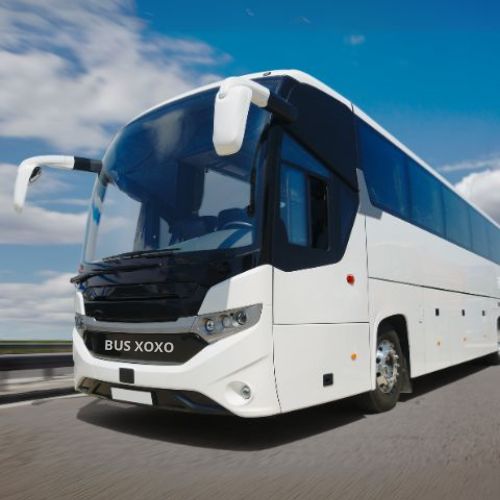
| Length | 40 to 45 ft |
|---|---|
| Width | 102 in (8.5 ft) |
| Height | About 11 to 12 ft |
| Axles | 2 (40 ft) or 3 (45 ft) |
| Seating layout | 2 + 2 with center aisle |
| Passenger seats | 47 to 57 |
| Under-floor storage | Roughly 300 to 450+ cu ft |
| Overhead racks | Full length, both sides |
| Restroom | Standard on most 45 ft coaches |
| Driver | CDL with passenger endorsement |
Figures describe the class in general. Your confirmation lists the exact coach assigned to your trip.
Seat map: how 56 seats become 51 on the day
Group leaders get caught by this more than anything else. You book a "56-passenger bus" for 56 people, then learn on departure morning that the coach assigned has a wheelchair lift position, the tour guide needs a seat, and one row was removed for legroom. Use the toggles below to see what each of those choices does to a standard 45-foot layout, then plan your headcount against the number that is left, not the number in the ad.
The spare-seat habit matters more than it looks. Coaches have no folding jump seats for latecomers, reputable operators will not let anyone stand on a highway run, and a 56-seat coach booked for exactly 56 means someone's carry-on ends up on a lap for four hours. If your count lands within three of the coach's real capacity, ask about a second smaller vehicle such as an executive Sprinter van rather than squeezing. Our blog post on what size charter bus you need walks through the same math for every vehicle class, and riders who care about where they sit can read our take on the safest seat on a charter bus and the window versus aisle debate.
Will your group fit? Check people and bags together
Seats are only half of the sizing question. A coach can have room for every person and still fail the trip because the bays are full by the 40th suitcase. Enter your headcount and the kind of trip you are taking; the planner suggests a vehicle mix and flags when luggage, not seating, is the limit.
Count chaperones, coaches, staff and the photographer.
Volume per person is an estimate. Oversized items like tubas or bike boxes should be listed on your quote request.
One full-size charter bus
The planner assumes 53 bookable seats per coach and about 350 cubic feet of usable bay space, which is a fair middle for a 45-foot coach. Real numbers move a few percent either way, which is why we confirm the exact coach before you finalize your rooming list. For smaller groups, the right answer is often not a full-size coach at all: an 18-passenger minibus or a 15-passenger van costs less per hour, parks more easily at downtown venues and still gets everyone there together. If you are deciding between two sizes right at the boundary, the comparison in our minibus versus coach bus guide is a useful tiebreaker, and teams with heavy kit should skim how much weight a charter bus can carry.
Two habits make the numbers in the planner hold up on the day. First, collect a real bag count a week before departure instead of assuming. A youth hockey team with goalie bags, a choir with garment bags or a corporate offsite shipping trade-show crates can each double the luggage estimate. Second, decide what rides inside the cabin. Coolers, strollers and instrument cases above carry-on size belong in the bays, and anything needed during the ride, such as medication, snacks or a laptop, should stay in a small bag under the seat. When luggage really does outgrow a coach, a towed luggage trailer is usually cheaper than adding a second full-size bus, though not every operator offers one and some venues have no room to park a coach with a trailer attached.
Where the full-size coach sits on the size ladder
Every step up the ladder adds seats, storage and comfort for long hauls, and every step also adds length that has to fit into hotel driveways, school loops and stadium lots. The highlighted row is the class this page covers. Click through any other row for the vehicle's own page.
| Vehicle | Seats | Luggage | Restroom | Sweet spot |
|---|---|---|---|---|
| 15-passenger van | up to 15 | Rear cargo area | No | Small teams, airport runs |
| Sprinter van | 10 to 14 | Rear cargo area | No | Executives, VIP transfers |
| 18 to 25 passenger minibus | 18 to 25 | Rear rack or small bay | Rarely | Wedding shuttles, city tours |
| 30 to 35 passenger minibus | 28 to 35 | Rear rack or small bay | Some models | Mid-size groups, under 2 hours |
| School bus | up to 70+ (bench) | None | No | Short local hops, budget events |
| 50-passenger charter bus | 40 to 50 | Under-floor bays | Usually | Groups of 35 to 45 |
| Full-size charter bus | 47 to 57 | Under-floor bays, 300 to 450+ cu ft | Standard on 45 ft | 35+ people or 2+ hours |
| 55+ passenger coach | 55 to 57 | Under-floor bays | Yes | Maximum single-coach groups |
| Executive coach | 20 to 40 | Under-floor bays | Yes | Leadership teams, roadshows |
Seat ranges reflect common U.S. charter layouts. Bar length is proportional to typical capacity.
Full-size, 50-passenger or 55-passenger: which page do I need?
Think of this page as the category and the other two as specific models. "Full-size" is the class decision: you need a high-floor motorcoach with bays and a restroom. Once that is settled, the 50-passenger page is the right read if your group sits around 35 to 45 and you want spare room, and the 55+ passenger page is the one to read if you are trying to fit the largest possible group on a single coach. Either way, your quote is built around the real seat count of the coach assigned.
When a smaller bus is the smarter buy
A full-size coach is not always worth its premium. For a 20-minute hotel-to-venue loop, two minibuses running staggered trips can move 60 people faster than one big coach, with less waiting at each end. Tight historic districts and some downtown curbs also restrict 45-foot vehicles. Our guides on shuttle bus versus motorcoach, charter bus versus Sprinter van and school bus versus charter bus break down where each one wins.
Full-size charter bus rental cost, explained line by line
Across our network, full-size coaches generally book between $180 and $350 per hour or $1,500 and $2,800 per day. That is a wide band, and the honest reason is that a quote is the sum of several separate decisions. Once you know what moves the number, you can usually move it yourself.
What changes the price
- Hours and the minimum
- Local trips are billed by the hour with a minimum, usually four or five hours. A 90-minute airport run still pays the minimum, so pairing it with a second movement the same day often costs almost nothing extra.
- Distance on long runs
- Beyond a certain distance, many operators switch from hourly to a daily or per-mile rate. A one-way trip can cost close to a round trip because the coach still has to drive home empty. Our guide to round-trip versus one-way rentals shows when one-way still pays off.
- Garage time
- The clock usually starts when the coach leaves its yard, not when it reaches you. Booking a coach based nearer your pickup is one of the quiet ways we lower quotes.
- Date and season
- April through June (proms, graduations, school trips), fall football Saturdays and December holiday weeks are the tightest. Moving a Saturday trip to a Thursday can drop the rate noticeably.
- Driver lodging
- On overnight trips you cover the driver's hotel room and sometimes a meal allowance. Federal rest rules make this non-negotiable, which we explain in the drive-time section below.
- Pass-through costs
- Tolls, airport commercial-vehicle fees, venue or national park entry fees for commercial buses, and city parking permits are added at cost.
- Gratuity
- Some quotes include it and some leave it to you. We state which on your quote. Our post on tipping a charter bus driver covers customary amounts.
For a deeper walk-through, read how charter bus pricing works and what it costs to rent a charter bus for a day. If you are weighing the coach against other options, compare it with flying the group or carpooling.
Three worked examples
Wedding guest shuttle, same city
50 guests, hotel to ceremony to reception and back, 5 hours
| 5-hour minimum at $210 to $280/hr | $1,050 to $1,400 |
| Venue parking or permit | $0 to $60 |
| Per guest | about $21 to $29 |
Out-and-back day trip
54 students, about 220 miles each way, 12-hour day
| Daily rate | $1,900 to $2,700 |
| Tolls and attraction bus parking | $40 to $150 |
| Per student | about $36 to $53 |
Three-day tour with two hotel nights
48 travelers, coach stays with the group throughout
| 3 days at $1,700 to $2,500/day | $5,100 to $7,500 |
| Driver hotel, 2 nights | $240 to $400 |
| Per traveler | about $111 to $165 |
Illustrative estimates only, built from typical ranges in our network. Actual quotes depend on city, date, coach availability and itinerary.
Trips where a full-size coach earns its keep
The same coach does very different jobs depending on who is aboard. Below is what the full-size class solves for each kind of group, plus the one planning detail our coordinators see overlooked most often for that trip type.
Corporate events and conferences
One coach replaces a fleet of rideshares between hotel and venue, so the whole team arrives at once and nobody files 40 expense reports.
Ask for the PA microphone to be tested at pickup if you plan a welcome briefing on the ride.
School and college trips
Seat belts, a restroom and under-floor bays make overnight band, choir and class trips workable for 50+ students and chaperones.
Districts often require the carrier's insurance certificate naming the school before the trip is approved. Request it early.
Sports teams and fans
Bays swallow equipment bags, and reclining seats help athletes recover between an away game and the ride home.
Tournament schedules slip. Build an hour of buffer into the hourly booking instead of paying overtime at the last minute.
Weddings
Moves an entire guest block from hotel to ceremony in one trip, which keeps the start time from drifting.
Rural venues may have gravel drives or low tree limbs. Share the venue address so we can check the approach for a 45-foot coach.
Church and faith groups
Retreats, youth camps and pilgrimages often run 3+ hours each way, where a restroom and comfortable seats matter most.
Multi-day trips need the driver's hotel booked near yours. Add it to your room block.
Concerts and festivals
One designated pickup point and one ride home beats 20 cars hunting for parking after the last set.
Large venues assign specific charter bus lots. Find out which one before the day so the driver is not turned away.
Airport and cruise transfers
Fifty travelers with checked bags is exactly what the bays were designed for. See our guide to cruise port transfers.
Airports restrict where coaches can wait. Send flight numbers so the driver times the curbside pickup.
Government and military groups
Moves full units or delegations on a fixed timeline with one point of contact and one invoice.
Base access usually requires driver details in advance. Plan for that lead time.
Casino and nightlife outings
A large group stays together and nobody has to be the designated driver.
Alcohol policies differ by operator and state. Confirm the rules before anyone packs a cooler.
Running something that does not fit a category, such as a film crew, a family reunion or a private group tour? Every trip type is listed on our group transportation hub.
How far one driver can take you in a day
Bus drivers work under federal hours-of-service rules written specifically for passenger carriers, and they are stricter than most people expect. These rules shape every long-distance quote we send, so it helps to know them before you sketch an itinerary. The full text lives on the FMCSA hours-of-service summary; here is the version that matters for planning.
What this means for your itinerary
As a working rule, one driver covers roughly 450 to 550 highway miles in a day once traffic, fuel and rest stops are counted. Anything longer needs either an overnight stop or a second driver who rides along and takes over. A second driver costs more than a hotel night for one person, but it can save your group an entire travel day, which is why cross-country tours and overnight band trips often choose it. Our guide to charter buses for cross-country trips works through both options.
The waiting-time trap
The 15-hour window is the rule that catches event planners. If a coach does a 7 AM airport pickup and then waits all day to run a midnight return from the reception, the driver may run out of legal time before the last ride. We plan around that by splitting the day between two drivers or two coaches, and we will flag it on your quote. Passengers sleeping through a late return will appreciate our tips on how to sleep on a bus and avoiding motion sickness.
Moving 100 to 500 people: running several coaches as one
Once a group passes about 53 travelers, the question shifts from "which bus" to "how do several buses behave like one." BUSXOXO regularly books multi-coach moves for conventions, graduations, university athletics and large weddings. The coaches are the easy part. Most problems on big moves come from people not knowing which bus is theirs. This is the sequence we use, and you can borrow it even if you book elsewhere.
- Number every coachPut a large printed number in the front windshield and the same number on each traveler's badge, wristband or ticket. Colors fade at dusk; numbers do not.
- Assign a captain per coachOne staff member, teacher or wedding party member owns the headcount on each bus and has the driver's cell number.
- Load by roster, not by crowdSend rosters 48 hours ahead. Captains check names at the door so friends do not quietly fill one coach while another leaves half empty.
- Stagger departuresRelease coaches 5 to 10 minutes apart. Venues unload faster, and one traffic snarl does not trap the whole group.
- Name a lead and a sweepThe lead coach carries the main coordinator. The sweep coach leaves last and picks up stragglers, lost phones and the person who was in the restroom.
- Plan the staging areaFour 45-foot coaches need roughly 200 feet of curb or a dedicated lot. Ask the venue where charter buses stage and send us the details.
Communication ties it together. Share one group text or radio channel between captains and the lead coordinator, keep a printed copy of every roster in case phones die, and agree in advance what happens if one coach is delayed: does the convoy wait, or does each coach run independently? Deciding that ahead of time avoids a parking-lot debate with 200 people watching.
For events that loop continuously, such as hotel blocks feeding a convention center, a mix of full-size coaches and shuttle buses often runs better than coaches alone. Planners comparing setups for staff transport may also find our pieces on employee shuttles versus carpooling and the benefits of charter buses for corporate events useful.
What is on board, sorted honestly
Most rental pages list every feature a coach could possibly have and add "on select buses" in small print. We would rather sort them by how likely you are to get each one, so nobody plans a four-hour movie marathon around a screen that turns out to be missing. If a feature is essential to your trip, put it on your quote request and we will confirm it in writing against the specific coach assigned.
Riders new to coach travel tend to ask the same few things: whether charter buses have bathrooms, whether they can eat and drink on board, and what counts as good charter bus etiquette. Each has its own short guide.
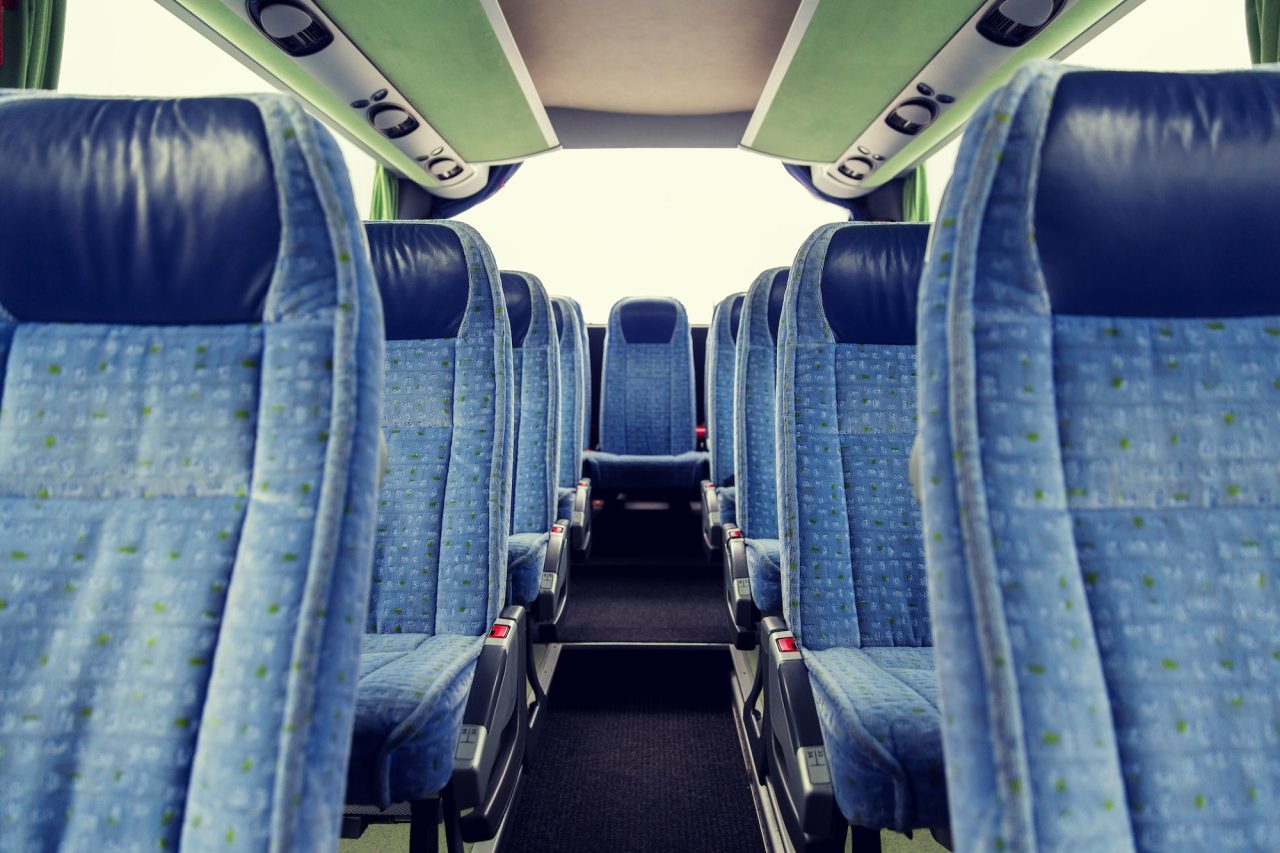
Standard
Expect these on virtually every full-size coach we book.
- Reclining padded seats in a 2 + 2 layout
- Air conditioning and heat with overhead vents
- Under-floor luggage bays and full-length overhead racks
- Reading lights at each seat
- PA system with a microphone up front
- Seat belts on newer coaches
Common, but confirm
Present on most coaches, though not every one, and worth confirming.
- Restroom at the rear (nearly universal on 45 ft coaches)
- Wi-Fi, which can weaken in rural areas
- Power outlets or USB ports at the seats
- Drop-down screens with a media input
- Footrests and seatback trays
Request in advance
Available, but only reliable when booked ahead.
- Wheelchair lift and securement, with at least 48 hours' notice
- Second driver for long days
- Luggage trailer for heavy gear
- Branded window signs for events
- Water service or a cooler, where the operator allows
That 48-hour figure is not arbitrary. Under the U.S. Department of Transportation's over-the-road bus accessibility rules, carriers can ask for up to 48 hours' advance notice to provide an accessible coach, so telling us early is the surest way to guarantee one. The ADA.gov site explains riders' broader rights. For a printable list to bring to your planning meeting, use our charter bus amenities checklist.
Not every full-size coach is the same coach
Two quotes for "a 56-passenger bus" can describe very different vehicles. One might be a coach built last year with seat belts, USB ports at every row and fresh upholstery; the other might be twenty years old and perfectly safe but plainer inside. Price differences between quotes often come down to this, so it is worth knowing roughly what each generation of coach offers.
Plain and dependable
Well-maintained older coaches still run thousands of safe trips a year. Expect reclining seats, a restroom and climate control, but outlets, Wi-Fi and seat belts may be missing. They are a reasonable budget choice for short local runs.
The connected middle
Many coaches from this period have outlets, drop-down screens and Wi-Fi, often added during refurbishment. Seat belts are common but were not yet required, so confirm them if they matter for your group.
Belted as standard
Federal safety standards require lap and shoulder belts at every passenger seat on new motorcoaches built from late November 2016, and newer heavy buses also carry electronic stability control. This is the generation schools and corporate travel policies increasingly ask for.
Beyond age, operators sometimes describe coaches as standard, deluxe or luxury. Those labels are not regulated, so judge them by the features listed rather than the name. If your group wants a higher-end ride with fewer seats and more space, an executive charter bus is a different product altogether; our comparisons of luxury versus standard coaches and electric versus diesel buses cover the trade-offs. The National Highway Traffic Safety Administration publishes the vehicle safety standards behind these changes.
Six questions to ask about the coach itself
- What model-year range will the assigned coach fall in?
- Does every seat have a seat belt, or only some rows?
- Is the restroom in service and cleaned before departure?
- Are outlets at every row, and is Wi-Fi cellular or satellite?
- Can you send photos of the coach type, inside and out?
- If the coach breaks down, how fast can a replacement reach us?
We answer all six on request, in writing, before you pay a deposit.
Check the carrier yourself in about five minutes
BUSXOXO arranges trips with licensed partner operators, and we screen each one before it carries a BUSXOXO group. You should not have to take that on faith. Every interstate passenger carrier has a public federal record, and your booking confirmation lists the operating carrier's USDOT number so you can look it up. Here is what a carrier snapshot on the FMCSA SAFER Company Snapshot tool looks like, and the four fields worth reading.
- USDOT number
- 0000000
- Operating status
- Authorized for passenger 1
- Carrier operation
- Interstate 2
- Operating authority
- MC-000000, active 3
- Insurance on file
- $5,000,000 required, $5,000,000 on file 4
- Safety rating
- Satisfactory, or not yet rated
- 1
Operating status. It should say the carrier is authorized for passenger service. "Not authorized" or "out of service" means the company should not be moving your group.
- 2
Carrier operation. Any trip that crosses a state line requires interstate authority. A carrier with intrastate-only registration can serve trips inside its home state but not beyond.
- 3
Operating authority. For-hire passenger carriers need active authority, shown with an MC number. "Inactive" or "revoked" is a hard stop.
- 4
Insurance. Federal rules set a $5 million minimum for vehicles seating 16 or more passengers. Check that the amount on file meets it.
Two more checks round it out. Ask whether your driver holds a commercial driver's license with a passenger endorsement, which every motorcoach driver needs, and browse FMCSA's passenger safety resources for the bus-rider checklist. Our own safety and trust standards explain how we vet partners, and our articles on whether charter buses are safe, modern coach safety features and choosing the right charter bus company go further.
Routes our groups book full-size coaches for
Long, scenic or luggage-heavy routes are where the full-size class beats every alternative. Here are some of the runs our partner operators drive most, with honest drive times and what the driver rules from the section above mean for each one. Each route links to a trip guide with stops worth building into your itinerary.
| Route | Approx. miles | Drive time | Driver plan |
|---|---|---|---|
| Los Angeles to Las Vegas | 270 | 4.5 to 5.5 hr | One driver, same day |
| Las Vegas to Grand Canyon South Rim | 275 | 4.5 to 5 hr | Overnight for a round trip |
| San Francisco to Yosemite | 190 | 4 to 5 hr | Overnight for a round trip |
| New York to Washington, DC | 225 | 4.5 to 5.5 hr | One driver, same day |
| Boston to New York | 215 | 4.5 to 5 hr | One driver, same day |
| Miami to Key West | 160 | 3.5 to 4.5 hr | One driver, same day |
| Orlando to Miami | 235 | 3.5 to 4.5 hr | One driver, same day |
| Dallas to Houston | 240 | 4 to 4.5 hr | One driver, same day |
| New York to Niagara Falls | 400 | 7 to 8 hr | One driver, plan an overnight |
| Seattle to San Francisco | 810 | 13 to 14 hr | Two drivers or two days |
| New York to Orlando | 1,080 | 17 to 18 hr | Two drivers or two days |
National parks deserve a special note. Many limit where tour buses can park or turn, and some require commercial use authorization for groups arriving by bus. The National Park Service lists rules park by park, and our guide to charter buses for national park tours covers the planning. Not sure where to go yet? Browse our destinations to visit by charter bus or the bus tours and road trips collection.
Your booking countdown, from first quote to departure
Full-size coaches are the first vehicles to sell out on busy weekends, because every large group in a city is chasing the same few dozen of them. Booking early is the cheapest upgrade you can make. This timeline shows what to settle and when, so nothing lands on the night before.
Quotes are free and come with no obligation. You can start online in about two minutes, or call a coordinator who will build the itinerary with you. Our step-by-step guide on how to rent a charter bus covers the same ground in more depth, and our cancellation and refund policy and terms and conditions are worth a read before you sign.
Start your quote- 8+ weeksRequest quotes and hold the dateShare headcount, dates, addresses and rough times. For April to June, December and big game weekends, start three months out.
- 6 weeksConfirm and pay the depositYour confirmation names the coach class, the operating carrier and its USDOT number, the included hours and what is billed separately.
- 2 weeksLock the itinerarySend final pickup addresses, venue loading details and stop times. Mention wheelchair needs and oversized gear now if you have not already.
- 48 hoursFinal headcount and rostersSend the passenger count and, for multiple coaches, rosters by coach. You will receive the driver's name and contact details.
- Day ofBoard and goThe coach arrives about 15 minutes early. Have travelers on site before that; see how early to arrive and our parking and pickup guidelines.
Booked nationwide, planned locally
Because BUSXOXO works through partner operators instead of running one regional fleet, we can usually find a full-size coach based close to your pickup point, which keeps garage time and cost down. Our state and city pages cover local venues, typical pickup spots and nearby day trips. A few of the busiest markets for full-size bookings are below, and the full locations directory lists every state.
Working through a network also helps on trips that cross regions. A group flying into one city and touring three states can keep the same coach and driver for the whole itinerary, or switch to a local operator at each leg if that is cheaper, and we can compare both before you choose. If you run a coach company yourself and want to carry BUSXOXO groups, see our partner operator program.
- Manhattan
- Brooklyn
- Newark, NJ
- Chicago
- Atlanta
- Orlando
- Miami
- Tampa
- Fort Worth
- San Antonio
- California
- Arizona
- Nevada
- Pennsylvania
Before you book
Comparing options
Full-size charter bus questions, answered
These are the questions our coordinators answer most often about the full-size class. Anything not covered here is probably in our general FAQ, or you can call +1 (308) 304-6668 any time, day or night.
How many people fit on a full-size charter bus?
Most full-size charter buses seat 54 to 56 passengers, and the class as a whole ranges from 47 to 57 seats. The exact number depends on the coach's length, whether it has a restroom and wheelchair lift, and how much legroom the operator built in. We recommend booking no more than the coach's real capacity minus two or three seats, so late additions and spare bags have somewhere to go.
How much does it cost to rent a full-size charter bus?
Across our network, full-size coaches typically run $180 to $350 per hour on local trips, with a four or five hour minimum, or $1,500 to $2,800 per day on longer trips. Season, day of the week, distance from the operator's garage, driver lodging and tolls all move the final price. Split across 50 riders, a full day often works out to roughly $30 to $55 per person.
Is a full-size charter bus the same as a coach bus or motorcoach?
Yes, in everyday booking terms they describe the same vehicle: a high-floor, 40 to 45 foot bus with forward-facing seats above under-floor luggage bays. "Charter" describes how it is hired, for one private group, while "coach" and "motorcoach" describe the vehicle type. Our coach bus versus charter bus article explains where the terms overlap.
Does a full-size charter bus have a bathroom?
Nearly every 45-foot coach has a compact restroom at the rear, and many 40-foot coaches do too. It is intended for occasional use on the road, not as a substitute for rest stops, which drivers schedule every few hours. If a restroom is essential, for example on a long trip with young children, note it on your quote so we can confirm it for the specific coach.
How much luggage can a full-size charter bus hold?
Under-floor bays on a full-size coach usually hold roughly 300 to 450 cubic feet, plus full-length overhead racks for small bags. That comfortably fits one large suitcase and one carry-on for each of about 50 travelers. Sports teams, bands and tour groups with bulky equipment can exceed it, in which case we arrange a luggage trailer or a separate gear vehicle.
Can I rent a full-size charter bus without a driver?
No. Operating a motorcoach requires a commercial driver's license with a passenger endorsement, along with drug and alcohol testing and hours-of-service compliance, so every full-size charter bus we book comes with a professional driver. The driver's time is already built into your hourly or daily rate.
How far in advance should I book a full-size charter bus?
Four to eight weeks ahead is comfortable for most dates. For April through June, fall football weekends, the December holidays or any group needing several coaches, book three months or more ahead. We can sometimes fill last-minute requests within a few days, but choice and pricing narrow quickly.
Will a full-size coach fit at my pickup location or venue?
A full-size coach is about 45 feet long, 8.5 feet wide and 11 to 12 feet tall, and needs a wide turning area. Hotel porte-cocheres, parking garages, gravel drives and low tree limbs are common problems. Share every pickup and drop-off address when you request a quote, and we will check the approach or suggest a nearby staging point.
Do I have to pay for the driver's hotel on overnight trips?
Yes. When a trip runs overnight, the group covers a hotel room for the driver, and sometimes a meal allowance, because federal rules require the driver to take at least eight consecutive hours off duty. Booking the driver's room in your own hotel block is usually the simplest approach.
Are full-size charter buses wheelchair accessible?
Many full-size coaches have a wheelchair lift and securement area. Under U.S. Department of Transportation rules, over-the-road bus carriers may ask for up to 48 hours' advance notice to provide an accessible coach, so tell us about mobility needs as early as possible. A securement position typically removes two to four seats from the layout.
Can passengers drink alcohol on a charter bus?
It depends on the operator's policy and on state law, and the answer differs for adult private events versus school or youth trips, where alcohol is never allowed. If your group plans to bring drinks to a wedding or private event, ask before booking so we can match you with an operator whose policy fits.
Can I book a full-size charter bus one way?
Yes. One-way trips are common for airport arrivals, cruise departures and relocations. Pricing often reflects the coach's empty return to its base, so a one-way trip may cost close to a round trip on long routes. Pairing it with another group's trip in the opposite direction is sometimes possible and can lower the price.
Is the driver's waiting time charged?
On hourly bookings, yes. The coach and driver stay assigned to your group while you are at the event, so the clock keeps running. Long waits also count toward the driver's 15-hour on-duty limit, which is why very long event days are sometimes split between two drivers.
Are full-size charter buses safe for school trips?
Motorcoaches are among the safest ways to move a group on the highway. Newer coaches have three-point seat belts, and every carrier we book must hold active federal authority and the $5 million minimum insurance required for buses seating 16 or more. Schools can ask for the carrier's insurance certificate and USDOT number before approving the trip.
Tell us your headcount and dates. We will find the coach.
Send the basics: how many people, where from, where to, and when. A BUSXOXO coordinator will match you with a full-size charter bus from a licensed operator near your pickup, explain every line of the quote, and stay reachable around the clock until your group is home.