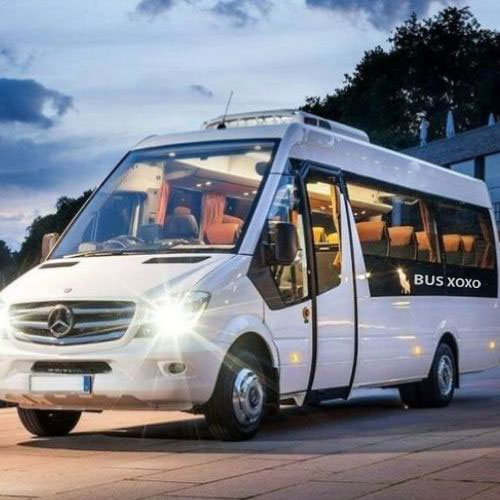
Sprinter Van
Quick, nimble and easy to park at small gyms and courses. Ideal for golf, tennis, cross country varsity squads and coaching staff runs.
- Seats6–14 by layout
- GearRear cargo area
- Best playSmall squads
- ParkingFits most lots
Group Transportation · Athletics
Your roster needs one thing from a bus company: show up early, load the gear, get everyone to warm-ups with legs that still feel fresh. BUSXOXO books Sprinter vans, minibuses and full motorcoaches with professional drivers for youth clubs, high school programs, college squads, booster clubs and fan groups across the U.S.
Prefer to read first? Start with the bus size calculator.
A wedding shuttle cares about elegance. A corporate transfer cares about Wi-Fi. A team bus cares about something else entirely: whether 22 players, four coaches, a trainer, two equipment bags per athlete and a water cooler all arrive together, on time, ready to compete. That difference shapes every recommendation on this page.
Parent carpools fail in predictable ways. Someone gets lost, someone leaves late, the kid with the first-aid kit rides in the wrong car. Charter travel solves the coordination problem by putting the whole roster in one place under one driver who has already mapped the route and the team entrance. Coaches use the ride for film or game plans. Athletes rest. Nobody is hunting for parking 40 minutes before tip-off.
We have arranged buses for one-off playoff runs and full seasons of away games. If you are new to chartering, our first-time rental guide explains the basics; if you organize trips for other kinds of groups too, the main group transportation hub covers every service we offer.
A U10 soccer club and a Division I travel party have little in common beyond the word "team." Supervision rules, budgets, trip length and who signs the contract all change with the level of play, so pick yours below.
Youth travel is really two trips running side by side: the players and the parents. Many clubs book a single coach for athletes and chaperones and let families drive separately, while others fill every seat with siblings and grandparents to split the cost per family. Both work. What matters is deciding early, because the answer changes the vehicle size.
Keep a printed roster with emergency contacts on the bus, assign one adult per eight to ten kids, and plan a bathroom stop every two hours for younger ages even when the coach has a restroom. Our guide to coordinating youth team and parent transportation walks through seating and pickup plans in detail.
Athletic directors juggle district policy, purchase orders and a schedule that can shift on a rainout. Many districts run their own yellow buses for short conference trips and charter coaches for long hauls, playoffs and state tournaments, when a few hours of reclining seats and an onboard restroom make a measurable difference to how players feel at warm-ups.
Check whether your district has a rule on vehicle type before booking. Many no longer allow 15-passenger vans for student travel, a stance backed by researchers such as NC State's Institute for Transportation Research and Education. For shorter hops, a school bus rental is often the approved choice; our comparison of school bus vs charter bus lays out the trade-offs.
Collegiate programs often pair a flight with ground legs on both ends, or skip the airport entirely for regional conference games inside a 300-mile radius. That is where a coach with power outlets and reliable Wi-Fi earns its keep, because student-athletes treat the ride as study hall. Ask about the Wi-Fi coverage on your route; our article on charter bus Wi-Fi lists the right questions.
Travel parties grow fast once you add trainers, video staff, equipment managers and band or spirit squads. Large programs frequently split into a team coach and a support coach. For flights, we coordinate airport charter bus pickups planeside or curbside where the airport allows it.
Minor league baseball, indoor football, pro soccer academies and semi-pro clubs live on the bus. Overnight legs after night games are common, which brings federal driver-hours limits into play. A coach leaving the ballpark at 11 p.m. for a 9-hour drive may need a second driver or a planned rest stop; our article on when a trip needs two drivers explains the math.
For media days, sponsor events and visiting-team shuttles, an executive charter bus with lounge seating fits the image. Our breakdown of executive vs standard coaches helps you decide whether the upgrade is worth it for your club.
The booster bus puts the student section and parents in the stands together, in their colors, without 30 cars hunting for parking at a rival stadium. These trips are usually one-way-there, one-way-back on the same day, with the bus waiting through the game. That waiting time matters in your quote, so tell us the expected final whistle, not just the kickoff.
Booster clubs often sell seats to recover the cost. Build a passenger manifest as you sell, collect a cell number for every rider, and post a clear return time. If the team advances and you want a bus for the next round, our last-minute booking checklist shows what to have ready.
Softball teams heading to a national qualifier, rugby sides on a tour weekend, masters swimmers, pickleball clubs and corporate leagues all charter for the same reason: nobody wants to drive four hours home after a day of competing. Adult groups also tend to celebrate after the final match, and a driver who is not a teammate is the safest end to that day.
If the trip mixes competition with a night out, ask whether alcohol is permitted on board; it varies by operator and state. For a looser vibe, some adult teams choose a party bus rental for the celebration leg and a standard coach for the competition leg. Golf groups should read our note on fitting golf clubs on a minibus.
Seat count gets you halfway. The other half is gear. A swim team and a hockey team with the same roster size need very different vehicles, so use this table as a starting point and the calculator below to fine-tune.
| Sport | Usual travel party | Gear reality | Where we usually start |
|---|---|---|---|
| Football | 45–75 players plus 8–15 staff for varsity | Helmets and pads in bags, plus sideline equipment, med kits and cooler carts. Bays fill quickly. | Two 55-passenger coaches, or one coach plus a gear vehicle |
| Ice Hockey | 20–25 players, 4–6 staff | The heaviest bag in sports, plus sticks that need a long bay. Never under-size a hockey trip. | A full-size coach even for one roster, so every bag fits in the bays |
| Basketball | 12–15 players, 3–5 staff | Backpacks, ball bags, a water cart. Light overall. | 30-passenger minibus, or a coach for a boys/girls doubleheader |
| Baseball & Softball | 18–24 players, 4–6 staff | Bat bags, catcher's gear, buckets of balls. Bats travel best in the bay, not the aisle. | A 35–40 seat minicoach or a standard coach |
| Soccer | 18–26 players, 3–5 staff | Ball nets, cones, pop-up goals for club events, shade tents. | Minibus for one team, coach for boys and girls together |
| Volleyball | 12–16 players per club team, often 2–4 teams | Light bags but multi-day tournament luggage. | A coach shared by several club teams |
| Lacrosse | 25–40 players, 4–6 staff | Long sticks and goalie bags. Ask for clear bay length. | 55-passenger coach |
| Wrestling | 14–30 wrestlers, 3–5 staff | Light bags; occasionally a rolled mat for hosted duals. | Minibus or school bus |
| Track & Cross Country | 30–90 athletes across events | Pole vault poles need a separate vehicle; the rest is light. | One or two coaches, plus a truck for poles |
| Swimming & Diving | 20–50 athletes | Wet bags and parkas. Seat-cover friendly vehicles help. | Coach with full luggage bays |
| Golf | 5–12 players, 1–2 staff | Golf bags are bulky for their headcount. | Sprinter van or 18-seat minibus with rear storage |
| Cheer, Dance & Band | 20–60 performers | Garment bags, props and instruments. See our band instrument loading guide. | Dedicated coach separate from the team |
A motorcoach typically carries several hundred cubic feet below deck. Our article on charter bus luggage capacity translates that into bags.
Heavy gear plus a full roster can approach axle limits on smaller vehicles. Read how much weight a bus can carry.
Bags in the aisle are an evacuation hazard. If the bays are full, you need a bigger bus or a gear van.
Every vehicle below comes with a professional driver. Exact seat counts vary by model year and operator, so your quote names the specific vehicle. Not sure where to start? Our guide to types of charter buses covers the full range.
Quick, nimble and easy to park at small gyms and courses. Ideal for golf, tennis, cross country varsity squads and coaching staff runs.
A driven passenger van for adult rec teams and staff. Many school districts restrict these for student travel, so confirm your policy first.
18SEATSThe sweet spot for one basketball or volleyball roster with coaches. Stand-up interior headroom on many models, plus rear luggage space.
30SEATSTwo small rosters, or a baseball team with staff and parents. Read minibus vs coach bus before you choose.
Built for repeated short loops: hotel to complex, parking lot to stadium gate. Tournament hosts love them for moving visiting teams.
48+SEATSThe approved, budget-friendly choice for short conference trips, field days and youth league shuttles. No bays, so gear rides in back seats.
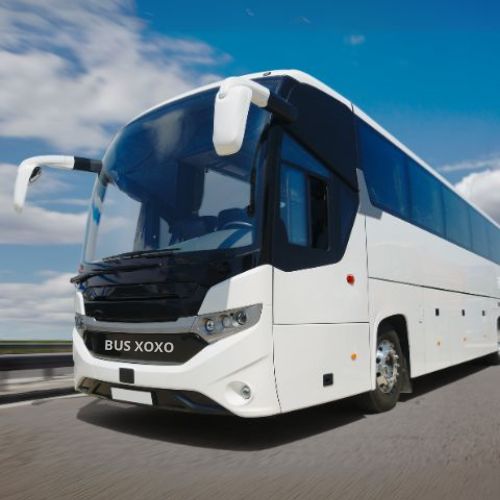
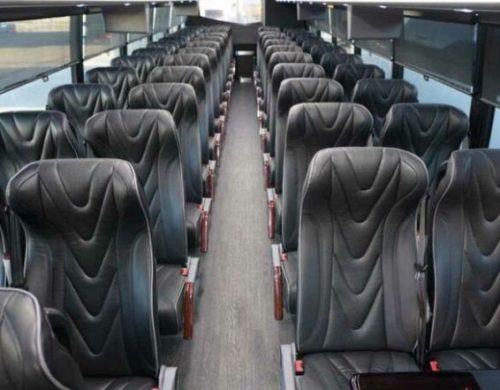
50SEATSFull underfloor bays, reclining seats and a restroom on most coaches. Right-sized for a lacrosse or soccer program with staff.
The classic team bus. Large rosters, booster sections and overnight tournament trips with luggage for every rider.
VIPLOUNGEFewer, wider seats, tables and lounge areas. Popular with college travel squads, pro staff and sponsor hospitality.
Comparing two finalists? Read charter bus vs Sprinter van, shuttle bus vs charter bus or luxury vs standard coach, or browse the full-size charter bus page for interior photos.
Coaches tend to count players and forget everyone else. A real travel party includes assistants, the athletic trainer, a statistician, the bus chaperone, maybe a few parents. Then the gear arrives. Enter your numbers and the calculator suggests a starting vehicle. It is a planning aid, not a booking, and it never shows a price; your written quote does that.
For the theory behind it, read what size charter bus do I need and how many seats are on a minibus.
A quick example: a varsity baseball team carries 20 players, a head coach, three assistants, a scorekeeper and a trainer. That is 26 riders before anyone mentions bat bags and a ball bucket. On paper an 18-seat minibus is too small and a 30-seat minibus looks perfect, but once bags take the back rows it gets tight. Many coaches end up choosing a coach with bays and inviting a few parents to fill the extra seats.
Press the button for a suggestion
We size for gear and a small buffer, then name the smallest vehicle that fits.
Good team travel runs on a backwards schedule. Start from warm-up time, work back to the driveway, and every decision gets easier. Here is how we pace a typical away game.
Send the final headcount, pickup address, venue address and the team entrance or bus lot if the host school has given you one. If the roster changed, our note on changing your passenger count covers what to tell us.
You receive the driver's name and a contact number the evening before. Check weather on the route, and share a one-page itinerary with parents so nobody texts the coach at midnight.
The coach pulls in 15 to 30 minutes before departure so gear can load first. Heaviest bags go in the bays nearest the door you will unload from at the venue. Trainers load the med kit last so it comes out first.
The bus captain checks every name off the manifest before the door closes. Build a 20-minute buffer for traffic into every leg; arriving early to a quiet gym beats sprinting from the parking lot.
Drivers aim for the visiting team entrance, not the main lobby. Large stadiums often have dedicated bus lots; our guides to AT&T Stadium and MetLife Stadium bus parking show how different venues handle it. Our general bus parking page covers the basics.
On most same-day trips the bus waits nearby, so bags can stay locked in the bays. Federal rest rules apply to drivers, so the wait counts toward their day. Read does the bus stay with your group before game day.
Double overtime, extra innings, a long post-game talk. Tell the driver as soon as you know, because extra time may affect the bill and the driver's hours. See what happens when an event runs long.
Food stop, quiet zone for players who want to sleep, and a second headcount before leaving the venue. Plan your parent pickup for the projected arrival time, and text one update on the road so families are not waiting in a dark lot.
Every program has its own traditions, but the best team buses share a pattern: staff up front where they can talk to the driver, younger players in sight, a quiet zone for players who need rest, and leaders in the back. Print the chart, tape it near the door, and the first ten minutes of every trip stop being a negotiation. On a full-size coach it maps neatly to rows; on a minibus, compress it to front, middle and back.
A tournament weekend is the hardest trip in team travel. Game times move, fields change, and your bus plan has to flex with a bracket nobody can predict. Our article on changing game times and return pickups goes deeper; here is the short version.
Fixed schedule, several games a day, often at different complexes. Book the bus "on call" for the day rather than point-to-point so it can shuttle between fields.
Seeding locks Saturday night. Send the new times as soon as the bracket posts, and confirm the driver's start time for the morning.
Checkout day for many teams. Load luggage at the hotel before the game so you can leave straight from the venue if you are eliminated.
Late finish, long ride home. Check whether the drive still fits a single driver's hours or needs a rest stop or relief driver.
Not every hotel can fit a 45-foot coach in its lot. Before you sign a room block, run through our hotel bus parking checklist.
On overnight trips, the driver needs lodging near the team. Sort out who books it early; our guide to driver hotel arrangements explains the norms.
Tournament directors use shuttle buses to loop visiting teams between host hotels and fields. Our multi-stop pickup guide helps you map the route.
Write every game time, field number and pickup on a single shared sheet, and update it the moment the bracket changes. The driver, coaches and parents all read from it, which ends the "which field?" texts.
Two teams from the same region heading to one event can split a coach. It works best when both clubs agree on hotel, departure and a return time before the bracket is set.
Long-distance qualifiers may beat airfare once you count bags and airport time. Compare with charter bus vs plane and our multi-day itinerary planner.
Fans travel differently from teams. They want the tailgate, the walk to the gate together, and a ride home where nobody has to stay sober enough to drive. A stadium bus turns a long day of parking fees, traffic and phone calls into one meeting point and one departure time.
Supporter groups, alumni chapters, sports bars and office outings book us for NFL Sundays, college rivalry games, MLB weekend series, NASCAR races and playoff runs. If you are organizing a concert at the same venue, our concert and festival charter page covers that crowd; for a workplace outing, see corporate event charters.
Big stadiums often restrict where charter buses can drop off and park, and those rules change by event. We confirm the bus lot or drop zone for your date before the trip. Pick a post-game meeting spot a short walk from the gate, because cell service fails when 70,000 people leave at once. Our guide to post-event pickup plans applies to any sold-out venue.
Planning around a specific stadium or arena? These guides cover parking, gates and what to do nearby.
Texas fans should read the best sports events in Texas for group travel. More venue guides live under our sports & entertainment tag, including Glass Bowl Stadium, Silver Spurs Arena and the Field of Dreams site.
We do not publish a one-size price because two team trips with the same mileage can quote very differently. Instead, here is what moves the number and how much, so your budget conversation with the AD or booster board starts in the right place. Every quote is written, itemized and free. For the general mechanics, read quote vs confirmed reservation.
One habit saves more than any discount: send the complete itinerary the first time. A quote built on "about 3 hours" becomes a different number when the real day includes a 7 a.m. pickup, a 9 p.m. finish and a dinner stop. Accurate inputs keep the final invoice in line with the quote you approved.
Fall Friday nights, spring tournament weekends and playoff weeks are peak. Weekday games in summer leave more vehicles open.
A coach with bays costs more to run than a minibus. An executive layout adds more again.
Billing usually counts from garage to garage, including the wait during the game.
Long legs may need an overnight stay or a relief driver to stay within federal limits.
Multiple pickup points, plus how far the bus travels empty to reach you.
Last-minute requests in peak weeks have fewer vehicles to choose from.
Venue bus lots and toll roads are passed through, never padded.
Parents trust you with their kids, and your school trusts you with its liability. These are the checks a careful AD runs on any carrier, including us. Our safety and trust standards and the article are charter buses safe? explain how we apply them.
Interstate passenger carriers need a USDOT number and operating authority. Look the operator up with the FMCSA's Look Before You Book tool and confirm the status is active.
Federal rules require at least $5 million in liability coverage for interstate carriers operating vehicles with 16 or more seats. Ask for a certificate naming your school or club if your district requires it.
Passenger drivers may drive up to 10 hours after 8 consecutive hours off and cannot drive after 15 hours on duty. The FMCSA hours-of-service summary has the full rules. A good operator plans around them for you.
Motorcoach drivers hold a commercial license with a passenger endorsement and are subject to federal drug and alcohol testing. Ask how long your assigned driver has been with the company.
New motorcoaches built since late 2016 come with lap and shoulder belts. Ask the model year, ask for belts if your policy requires them, and have the bus captain remind riders to buckle up.
If an athlete, coach or fan uses a wheelchair, request a lift-equipped coach early. Read how to request an accessible bus and the ADA.gov guidance for transportation providers.
The FMCSA also publishes a passenger safety page for trip planners. Bookmark it and share it with your booster board so everyone knows what "safe" means before a vote.
Team bus demand follows the sports calendar, and it collides with proms, graduations, band trips and holiday travel. Darker months below are when vehicles sell out first. Your exact peaks depend on your state association calendar, which the National Federation of State High School Associations links to from its site.
Book as soon as your schedule is published. Season-long bookings get first pick of vehicles for every date on the calendar.
You will not know the opponent until days out. Tell us your possible dates early and we will track availability so you can confirm fast. Use our short-notice checklist.
Summer camps, preseason retreats and team-building days are the easiest trips to book. Use the quieter months to set up your season schedule with us before fall demand arrives.
December travel overlaps with family holidays and airport rushes. Book bowl-game and holiday tournament buses as soon as the invitation arrives.
Weather moves games. Read rescheduling a charter date and our terms so a postponement does not become a scramble.
We serve teams nationwide, so this is not a list of every city. It is a short list of places where team travel has its own wrinkle, with a link to the local page that covers vehicles and pickup details. Everywhere else, start at our locations directory.
Flying a team into Texas? Read our DFW airport group pickup guide and how airport pickups work. Traveling through the South? We also cover Louisiana, Mississippi and the District of Columbia, plus cities such as San Antonio, El Paso, Orlando, Miami, Jacksonville and Brooklyn.
Dates, departure times and venue addresses for every game you want covered. One trip or a full season both work.
Athletes, staff, chaperones and any fans, plus a gear description. Use the calculator if you are unsure.
Submit the online booking form or paste the template here into an email via our contact page.
You get a written quote naming the vehicle, timing and inclusions. Your bus is held once the agreement is signed and any required deposit is paid.
Send the manifest and any changes 72 hours out. You get driver details the day before.
Organization / team: Sport and level (e.g. varsity girls soccer): Contact name, phone, email: Trip date(s): Pickup address and departure time: Venue address(es) and game/warm-up time: Expected return time (include possible overtime): Riders: __ athletes, __ staff, __ parents/fans Gear: light / standard / heavy (describe) Overnight? Hotel name and address: Vehicle preference (if any): Wheelchair lift needed? Y / N Payment: card / check / purchase order Notes (district rules, belts, alcohol policy):
Booking for a church league, a military base team or a private club? Our church bus, government and military transport and private bus rental pages cover those booking paths. Want to see what other groups say first? Read our testimonials.
Straight answers to what coaches, athletic directors and booster presidents ask us most. General booking questions live on our main FAQ page.
It depends on the date, vehicle size, total hours on the clock, mileage, and whether the trip runs overnight. Two trips of the same distance can quote very differently if one includes a four-hour wait during the game. We send a free, itemized written quote for your exact itinerary. See what drives sports bus rental cost for the factors that matter most.
Add athletes, coaches, trainers, chaperones and any parents, then consider gear. Light-gear teams of up to about 14 fit a Sprinter van; one basketball or volleyball roster fits an 18-passenger minibus; football, hockey and lacrosse programs usually need a full 55-passenger coach for the bays alone. Try the team bus size calculator.
Book regular-season games as soon as your schedule is published, and earlier for September through November and March through May, when athletics overlap with proms, graduations and field trips. Playoff buses can often be arranged with a few days' notice, but vehicle choice narrows. Telling us your possible playoff dates early helps.
On most same-day trips, yes. The driver stays nearby so gear can stay locked in the bays and the team can leave right after the final whistle. Wait time counts toward the driver's on-duty hours and your total booking time, so share realistic end times. Our article on whether the bus stays with your group explains more.
Yes, within the space of the vehicle. Motorcoaches have large underfloor bays for team bags, sticks and coolers. Minibuses and vans use rear storage or seats. Bags may not block the aisle. If you have pole vault poles, rolled mats or a large amount of heavy gear, tell us so we can add a gear vehicle or size up.
Usually, if there are seats and your school or club policy allows it. Many youth clubs fill a coach with athletes and families to share costs. High schools often limit the team bus to athletes and staff and run a separate booster bus for parents and students.
We work with licensed, insured carriers whose drivers hold commercial licenses with passenger endorsements and are subject to federal drug and alcohol testing. You can check any carrier's status with the FMCSA Look Before You Book tool. Read our safety and trust standards.
Sometimes. Federal rules limit passenger drivers to 10 hours of driving after 8 hours off and no driving after 15 hours on duty. A late championship game followed by a long drive home may exceed that, so we plan either an overnight stay or a relief driver. See when a trip needs two drivers.
Yes. We regularly coordinate several vehicles for football programs, multi-team clubs and booster sections. Each bus gets a number, a captain and a manifest, and drivers share a common timeline. Our boarding plan guide shows how to keep headcounts straight.
Many schools and districts pay by purchase order or check. Mention it in your quote request so the paperwork, invoice details and certificate of insurance match what your business office needs.
It depends on the operator and state law, and it is never allowed on buses carrying minors. Adult fan groups should ask before the trip so there are no surprises at the door. Drivers can refuse service to anyone who is unsafe or disruptive.
Contact us as soon as the change is announced. Depending on timing and availability, we can usually move the booking to the new date. Review our refund policy and the general charter FAQ so you know the terms before weather season.
Send the schedule, the headcount and the gear list. We will come back with a written sports bus rental quote that names the vehicle, the timing and everything included, so the only thing left for game day is the game.
Corporate · Weddings · Group Travel
Toll-Free · Available 24/7